Labels
Drag — or tap a label, then tap a dot!
Horses & Knowledge
Whether you're a new rider just starting out or a lifelong horse lover brushing up on your knowledge, understanding the body parts of a horse is super important. From the poll to the hooves, every part of a horse has a name — and knowing those names helps you communicate better with vets, trainers, and others in the horse world.
We've built a free interactive horse body parts diagram just for you! Choose your difficulty level and see how many parts you can name. It's a fun way to learn horse anatomy!
This page may contain affiliate links which may earn a commission.
Ready to test your knowledge? Choose a difficulty level and start labelling — can you name all 37 parts?
Can you label all the parts of a horse? Choose your level to find out!
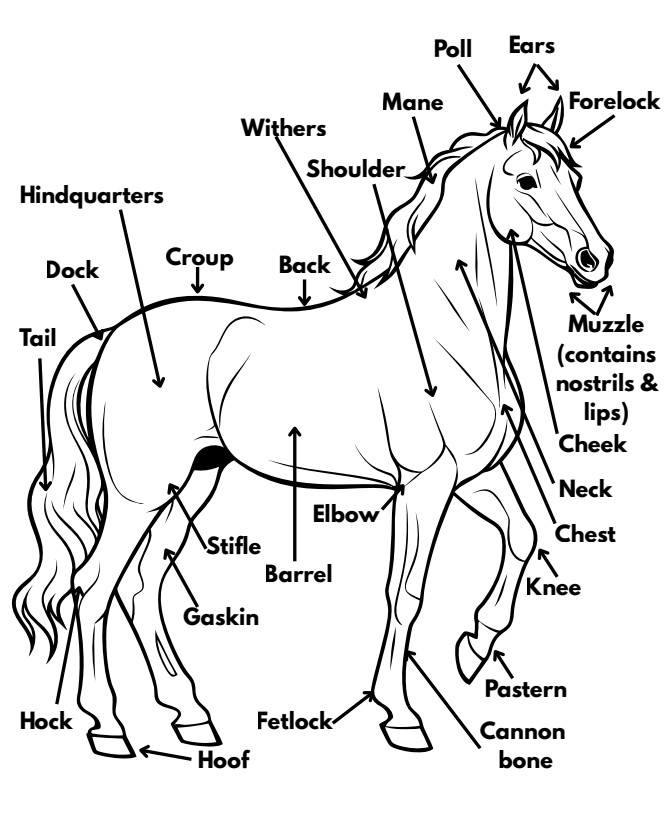
Check out this outline of the major regions of a horse's body. Use it alongside the game above to build a solid foundation in horse anatomy.
The poll is the very top of the head, right between the ears (which are pretty easy to identify), and it's one of the most sensitive spots on a horse's body. The part of the mane that runs over the poll, through the ears, and down the forehead is called the forelock.
Moving down the face, you reach the muzzle — the soft, whiskery area around the mouth that includes the nostrils and lips. On sides of the face near the forehead you of course see the horse's eyes and further down you reach the cheek (the wide, flat, 'half circle' looking area of the face). The throatlatch is the area where the head meets the neck.
The topline of a horse runs from the poll all the way to the tail, and it tells you a lot about a horse's health and fitness. The crest is the top of the neck where the mane grows out of. On the top of the horse near where the mane ends and there is usually a dip down to the back there is a bony ridge that is the withers which is the standard point for the top of the measuring stick when measuring a horse's height.
Behind the withers comes the back. The loin sits just behind the back, over the kidneys, and the croup is the rounded area over the hindquarters. The very end of the spine is the dock, which continues into the tail.
The shoulder is easy to identify as it is so large. The point of shoulder is the bony protrusion at the front of the shoulder joint, where the bottom of the neck and shoulder meet. Below and behind the shoulder is the barrel — the large, rounded midsection of the horse's body that houses the lungs and digestive system. Behind the barrel is the flank, the soft area between the ribs and the hindquarters.
The hindquarters is another easy area of the horse to identify as it is a big area as well. This region includes the point of hip (the bony protrusion on either side of the croup), the stifle (which is equivalent to a human's knee and is located on the inside of the hind leg), the gaskin (the muscular area between the stifle and the hock), and the hock (a complex joint in the hind leg equivalent to the human ankle).
On the front legs, you'll find the elbow (at the top of the leg, where it meets the body), the forearm (the large muscle that runs between the bottom of the shoulder and knee), the knee (the large joint halfway down the front leg), the cannon bone (the long bone below the knee), the fetlock (the joint the juts out and has a sort of tennis ball look near the hoof), the pastern (the short, angled bone between the fetlock and the hoof), and the hoof itself.
The hind legs follow a similar pattern below the hock: cannon bone, fetlock, pastern, and hoof. Want to go deeper on the hoof? Check out our dedicated guide to the parts of a horse hoof for everything you need to know about this incredibly complex structure.
All 37 major external body parts in one place — great for studying, 4-H quizzes, and horse knowledge classes.
| Body Part | Where It Is |
|---|---|
| Poll | The very top of the head, between the ears |
| Forelock | Mane that falls from the poll between the ears |
| Ear | On either side of the poll |
| Eye | On the side of the face, pretty easy to identify |
| Muzzle | The soft 'nose and mouth area', that has the nostrils, whiskers, and lips |
| Cheek | The wide, flat, semicircle area of the face |
| Throatlatch | Where the head meets the neck |
| Crest | The top part of the neck the mane grows out of |
| Mane | The hair growing from the crest of the neck |
| Withers | The ridge between the shoulder blades at the base of the neck |
| Shoulder | The large bone between the withers and the foreleg |
| Point of Shoulder | Bony protrusion at the front of the shoulder joint |
| Chest | The front of the body between the forelegs |
| Elbow | Front leg joint near the end of the back of the shoulder where leg meets body |
| Forearm | Front leg muscle between the bottom of the shoulder and knee |
| Knee | Large joint halfway down the front leg |
| Cannon Bone | Long bone below the knee or hock |
| Fetlock | Joint above the hoof with soft of a tennis ball shape |
| Pastern | Short angled bone between fetlock and hoof |
| Hoof | The hard foot at the bottom of the leg |
| Back | The area from withers to loin |
| Barrel | The rounded midsection housing lungs and stomach |
| Loin | Area over the kidneys, behind the back |
| Flank | Soft area between the barrel and hindquarters |
| Croup | Rounded area over the hindquarters |
| Point of Hip | Bony protrusion at the top of each hip |
| Hindquarters | The entire muscular rear section of the horse |
| Dock | The end of the spine that extends into the tail |
| Tail | The hair at the end of the dock |
| Stifle | The 'knee' joint of the hind leg |
| Gaskin | Muscular area between stifle and hock |
| Hock | Major hind leg joint equivalent to the human ankle |
Horse legs are surprisingly complex. Here's a quick top-to-bottom breakdown of both the front and hind legs so you always know exactly what's what.
Want to know what's inside the hoof? Check out our full guide to the parts of a horse hoof — including the frog, white line, sole, and more.
Knowing the correct names for every part of a horse isn't just trivia — it's the foundation of good horsemanship. Here's why it matters:
When your horse has a sore spot or an injury, being able to point to the exact body part saves time and helps get the right treatment faster.
Almost everything written about horse care, riding, and training uses proper anatomical terms. Knowing them opens up a whole new world of learning.
Understanding terms like 'long sloping shoulder' or 'well-angulated hock' lets you evaluate horses the way the pros do.
A saddle that sits on the withers, a browband that pinches behind the ears, or a girth that rubs the elbow — these are all issues you can only identify and fix if you know your horse anatomy.
Many youth horse shows include a horse knowledge class where you'll be asked to identify parts of the horse. This page is your study guide!
Everything you ever wanted to know about horse anatomy — answered.
Our products are available in our Horse Crazy Girls Etsy shop .